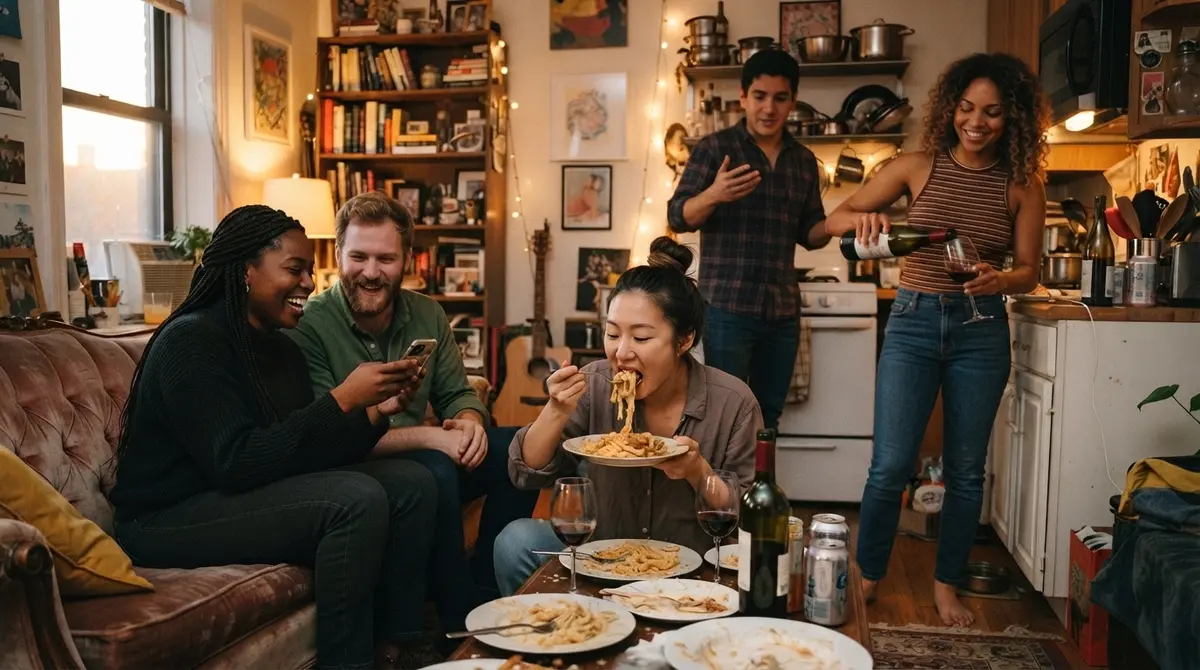
Think back to the last time you were actually invited into someone's home, not a bar, not a restaurant, not a group chat, their actual living room, for no reason other than to hang out. If you have to scroll back further than you would like, you are not imagining the drought. Americans have been quietly opting out of hosting each other for two decades, and the data on just how far it has fallen is more dramatic than the vibe alone would suggest.
According to the federal government's own American Time Use Survey, the time Americans spend attending or hosting social events has dropped by roughly 50% since 2003. For adults aged 15 to 24, the group you would expect to be out the most, the decline is closer to 70%. On a typical weekend or holiday in recent years, under 4% of Americans reported hosting or attending any kind of gathering at all, down from roughly double that just two decades earlier. The house party, the potluck, the Sunday dinner with the same six people, is not just less common. It is close to extinct.
This did not happen because people stopped liking each other. It happened because hosting quietly became one of the most expensive, most anxiety-inducing things we ask of ourselves socially, right as everything else in life got more expensive and more anxiety-inducing too. Understanding why is the first step to getting some of it back, and you do not need a dinner party to do it.
The numbers behind the empty living room
The scale of the drop is easy to miss because it happened so gradually. As recently as the late 1990s, the average American household hosted or visited friends' homes several times a month, with roughly three-quarters of Americans getting together at someone's home at least once a month. Today, that kind of casual, recurring home socializing is the exception, not the norm.
It is not a one-generation story either, though it hits young adults hardest. Face-to-face socializing across all age groups has been sliding for years, and the newest 2025 American Time Use Survey data shows the decline accelerating rather than leveling off, with time spent socializing on an average day continuing to shrink even as time spent alone at home climbs. We are not swapping house parties for something else social. We are mostly just swapping them for solitude.
That matters because, as we covered in the loneliness epidemic, the gap between wanting connection and actually getting it is the defining social problem of this moment. Hosting used to be one of the main bridges across that gap. It is worth understanding why we let it crumble.
"Protecting your peace" quietly became an excuse to withdraw
Part of the explanation is cultural, and it traces back to something that started as genuinely good advice. Self-care culture, at its origin, was about setting boundaries against people who took advantage of you. Somewhere along the way, it broadened into something closer to a permission slip for skipping obligations to the people who never took advantage of you at all.
Psychologist Amber Wardell, writing about the shift, put it bluntly: the self-care movement "seems to have lost its way," drifting from teaching people to protect themselves from manipulation into a blanket justification for opting out of mutual support. Hosting a party costs the host something real: time, money, cleaning, the low-grade dread of whether anyone actually shows up. It offers no guaranteed personal payoff in the moment, only the promise of a stronger community later, which is exactly the kind of trade a culture optimized for immediate self-protection tends to talk people out of making.
The irony, as more than one writer on the topic has noted, is that the "mild woes" of throwing something together are almost always outweighed by what you get back: an evening that actually happened, instead of one more solo night that quietly dissolved into a phone screen.
The practical reasons are just as real
Culture is not the whole story. A lot of the retreat from hosting is straightforwardly logistical, and it disproportionately hits exactly the people this decline is worst for.
Space and money are tighter. If you are renting a room in a shared apartment, or living somewhere you would rather not invite people into, hosting is not a mindset problem, it is a math problem. Renters and younger adults describe the calculus bluntly: the financial pressure and cramped square footage make hosting feel like "putting myself through stress for no reason."
Perfectionism raised the bar. Social media rewarded the tablescaped, styled, magazine-ready version of hosting, and quietly punished everything less than that. If your instinct is that your apartment has to look a certain way before anyone can see it, you will host a lot less often than the generation before you, who mostly just put out chips and folding chairs.
Parenting eats the spontaneity. Time-use data shows college-educated parents added more than nine hours a week of childcare time between the 1970s and the 1990s alone, and that trend has only intensified since. A spontaneous Tuesday hang becomes a scheduling project once it requires a babysitter, a bedtime negotiation, and a cost-benefit analysis most parents are simply too tired to run.
Nobody wants strangers touching their stuff. Homeownership raised the emotional stakes of hosting in a different way. People who worked hard to buy a place are often more protective of it, not less, which sounds backwards until you remember how much harder that place was to get.
The hidden labor question nobody asks
There is a quieter thread running underneath all of this: someone always had to be the one organizing the get-together, and for most of American history, that job fell disproportionately on women. Sociologists call it "kinkeeping," the largely invisible work of remembering birthdays, sending invitations, planning menus, and keeping a social calendar alive for an entire friend group or extended family.
When women's workforce participation surged past 50% in the 1970s, that unpaid planning labor did not get redistributed, it mostly just stopped happening as often, because the people who had quietly been doing it now had far less spare time to do it in. It is a dynamic that echoes what we found writing about the male friendship recession: men are statistically far less likely to be the one who initiates a hangout, which means when the default organizer in a friend group burns out or gets busy, plans often just stop happening rather than someone else stepping up.
There is also a documented emotional-closeness gap that compounds this. Research on the gender gap in friendship closeness has found men report feeling meaningfully less emotionally close to their best friend than women do on average, which makes the disappearance of low-stakes hosting opportunities, the exact setting where that closeness tends to get built, an even bigger loss for exactly the group that needs it most.
What actually gets lost when the invitations stop
It would be one thing if hosting were just an old-fashioned nicety that got replaced by something equally good. It was not. Therapists who study relationships point to something specific that happens inside a home that does not happen anywhere else. "At ours or a friend's place we may feel more inclined to relax, be ourselves and even divulge things we may not want to discuss in public," therapist Caroline Plumer told Refinery29, and fellow therapist Liz Kelly put it just as plainly: hosting people in your home is one of the fastest ways for others to actually get to know you.
Bars and restaurants are wonderful for a lot of things. They are loud, time-boxed, and built for turnover, not for the specific kind of unhurried vulnerability that happens on someone's couch at 11pm when the original plan was to leave by 9. That is a big part of why we have also written about the third-place crisis: public gathering spots and private hosting were never substitutes for each other. Losing both at once is a genuinely bigger loss than losing either on its own.
Flakiness made the whole thing feel not worth the risk
Even when people do work up the nerve to plan something, there is a newer problem making it worse: nobody trusts the RSVP anymore. A recent survey on party planning found that 62% of hosts say their biggest frustration is guests who confirm and then simply do not show up, and a similar share point to vague, incomplete invitations as a source of what researchers are now calling "planxiety," the low-grade dread of planning anything at all because you cannot predict who will actually turn up.
That uncertainty raises the cost of hosting even further. If you cook for eight and three show up, the math on "worth it" gets a lot harder, which is exactly the kind of friction we wrote about in quiet quitting friendships: a huge amount of social withdrawal is not really about not caring, it is about the planning overhead finally outweighing the payoff.
You do not need a dinner party. You need a lower bar.
The good news buried in all of this research is that almost none of it requires reviving the full 1975 dinner-party ritual to fix. The bar for a meaningful gathering has always been lower than self-care culture, Instagram, and planxiety made it feel.
Stop treating "hosting" as one big production. A gathering does not need a menu, a cleaning spree, or a theme. It needs people and a reason to be in the same place. Ordering pizza and putting on a game counts.
Move the gathering out of your apartment if the apartment is the barrier. If space, mess, or privacy is what is actually stopping you, you do not have to solve that before you can gather people. Proposing an activity out, a walk, a pickup game, trivia at the place down the street, gets you the same low-stakes togetherness without needing your living room to be guest-ready. This is a big part of why Let's exists: you post the plan you are actually up for, and people who want in can join, no cleaning, no cooking, no pressure to be the perfect host of a perfect space.
Let someone else carry the invite. If kinkeeping has quietly fallen on one person in your circle for years, the fix is not guilt, it is redistribution. Posting a plan on Let's means anyone in the group, not just the designated planner, can be the one who gets something on the calendar this week.
Solve the flakiness problem structurally, not through willpower. Instead of a group text that seven people half-commit to and three quietly bail on, a plan where people opt in individually tends to hold up better. That is the whole model behind Let's: you post what you are doing, people nearby say they are in, and the host approves who actually joins, so the guest list is made of people who showed up on purpose, not people guilt-tripped into a maybe.
Keep the guest list small on purpose. Kinkeeping and Instagram culture both pushed toward big, impressive gatherings. Two or three people around a table gets you almost all of the intimacy researchers describe, for a fraction of the planning cost.
The invitation is still worth sending
None of the forces behind this decline, the cost of living, the burnout, the flaky RSVPs, are anyone's personal failing. But the research is consistent on one point: the antidote is not waiting for the perfect apartment, the perfect free weekend, or the energy for a full dinner party. It is lowering the bar on what counts as gathering people, and then actually doing it.
You do not have to become the friend who hosts elaborate dinners every month. You just have to be willing to be the one who sends the text, or better, the one who posts the plan and lets people show up for something real instead of one more night dissolving into a group chat that never becomes a get-together. The house party is not dead. It just needs someone to go first, and that someone can be you, tonight, with a lot less effort than you think.