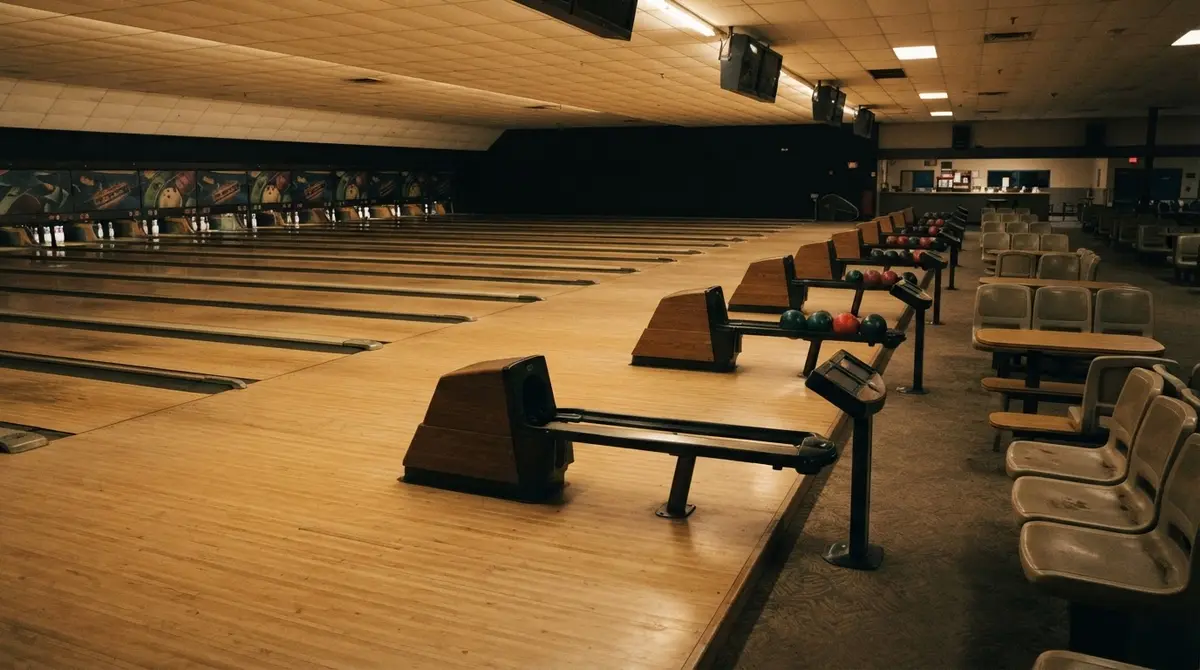
Ask someone over 60 where they made their closest friends and the answer is rarely a plan. It's a place. The bowling league. The church basement. The corner bar where the same six people showed up every Thursday whether anyone invited them or not. Ask someone under 30 the same question today, and the honest answer is often: nowhere, really, and that's the problem.
Sociologist Ray Oldenburg had a name for those places back in 1989. He called them "third places," the ones that are neither home (first place) nor work (second place): the cafés, taverns, barbershops, rec leagues, and community halls where people showed up regularly, expected nothing formal, and became friends almost by accident. Oldenburg argued even then that America was losing them. Thirty-five years later, the data suggests it wasn't a passing worry. It was an early warning.
What a "third place" actually does for you
The genius of a third place was never the coffee or the beer. It was the repetition. You didn't have to plan anything. You just had to keep showing up, and eventually the same regulars became familiar faces, then familiar faces became friends. Psychologists call this the mere-exposure effect: we grow to like people simply through repeated, low-stakes contact. Third places were the delivery mechanism. They made friendship a side effect of your week instead of a project you had to manage.
That infrastructure has been quietly dismantled for decades. Political scientist Robert Putnam documented the collapse of American civic and social life in Bowling Alone, noting that attendance at groups like Rotary and Kiwanis clubs fell by more than half between 1975 and 2000. Since then, the slide has continued on nearly every front: religious attendance has dropped more than 20 percentage points since the 1990s, independent bars and cafés keep getting replaced by chains optimized for turnover rather than lingering, and shopping malls, once the default teenage third place, are closing at a record pace. Public space itself has increasingly been designed to discourage the exact thing third places require: sitting around with no purchase in hand and no agenda.
The numbers behind the disappearance
If this sounds like nostalgia, the federal government has been quietly tracking it for over 20 years. The American Time Use Survey shows that face-to-face socializing among American adults fell by roughly 30% between 2003 and 2022. Unmarried adults saw declines above 35%. Teenagers, the group with the most to lose, saw drops of more than 45%, going from spending roughly an hour a day with friends to barely more than half that.
The consequences are showing up everywhere researchers look. A landmark AARP study surveying nearly 1,500 U.S. adults in late 2025 found that 95% now say friends are essential to a happy, healthy life, up from 90% in 2019. We know how much we need this. We're just getting less of it: the same study found adults report fewer close friends than they had five years ago, with nearly half saying it gets harder to make friends with age, citing time constraints and a shortage of places to even try.
It's a global pattern, not just an American one. An eight-country study led by researchers at Washington University published in March 2026 found nearly 40% of adults across Brazil, France, India, Indonesia, Nigeria, the Philippines, Turkey, and the U.S. report loneliness, and among 18-to-24-year-olds that figure climbs to nearly half. People who reported loneliness had almost three times the odds of screening positive for depression and nearly four times the odds for generalized anxiety. This isn't a mood. It's measurable, and it scales with age in the opposite direction most people expect: the young are the loneliest.
Harvard's Graduate School of Education reached a similarly specific conclusion in its Loneliness in America report: 67% of lonely respondents said they didn't feel part of any meaningful group, and 61% said they simply didn't have enough close friends. A related Harvard Kennedy School poll covered by CNBC found only 17% of Americans under 30 feel deeply connected to a community at all. Put plainly: most young adults today are not lacking the desire to belong somewhere. They're lacking the somewhere.
Why this hits young adults the hardest
It's tempting to blame phones and stop there, and screens are clearly part of the story. But the third-place lens explains something phones alone don't: why the loneliest people are often the most digitally connected ones. You can be in six group chats and still have nowhere unplanned to go on a Tuesday night. Texting can maintain an existing friendship, but it's a poor substitute for the accidental, repeated, in-person contact that starts one in the first place. Without a physical, recurring place to occupy, there's no mechanism left for turning strangers into regulars, and regulars into friends.
Young adults feel this most acutely for a structural reason: they've just lost the last built-in third place many people ever had. School and college manufacture proximity and repetition automatically, whether you want it or not. The day that ends, so does the machine. As we've written about in the loneliness epidemic, the gap between wanting connection and actually reaching it tends to open up exactly at this transition, and it rarely closes on its own. It's also consistent with what the WHO's 2025 Commission on Social Connection found when it put a number on the global toll: roughly 1 in 6 people worldwide are affected by loneliness, and young people report some of the highest rates of anyone.
It's not only a Gen Z problem
The third-place collapse hits hardest right after college, but it doesn't stop there. Remote and hybrid work has quietly erased a lot of people's "second place" too, the office desk next to yours, the coworker you grabbed lunch with, the small talk that occasionally turned into something real. Lose that, and you've lost two out of your three places in the same stretch of years, right around when people are also most likely to move cities for a job or a relationship and start over with zero built-in social infrastructure.
That combination, no office friction and no default third place, explains why "I moved somewhere new and don't know anyone" has become such a common refrain, even among people who are objectively good at making friends. It was never really about being bad at socializing. It's that the machinery that used to do a lot of that work automatically simply isn't there anymore, in your building, your job, or your neighborhood. You're not failing at something people used to be naturally better at. You're doing something people used to get significant structural help with, largely on your own.
The hopeful counter-trend: people are rebuilding third places on purpose
Here's the part that should make you optimistic rather than resigned. The appetite for a third place never went away. What changed is that people had to stop waiting for one to be handed to them and start building their own, on purpose.
The clearest evidence is the run club boom. Strava's 2026 Year in Sport data shows running clubs growing 3.5 times year-over-year, with more than a million clubs now active on the platform. Gen Z is driving it: 72% say they join primarily to meet people, not to shave time off a mile. Strava's framing of the trend was blunt but accurate: doomscrolling is out, movement is in. Forbes has called it a full "third space boom" for 2026, pointing to run crews, pickleball leagues, and walking groups as the new corner bar: a recurring, low-stakes, activity-first reason to show up around the same people again and again.
What run clubs get right is exactly what old third places got right, minus the assumption that the space would just exist for you. They give people a reason to be in the same place at the same time doing the same thing, repeatedly, with strangers who become familiar and then become friends. The activity is the icebreaker. Nobody has to awkwardly "hang out." They just have to show up and run, or play, or walk, and the friendship builds itself in the margins.
Closing the gap yourself
You don't need to wait for your neighborhood to grow a new corner café. A few things the research (and the run club data) makes clear actually work:
- Anchor to an activity, not a vibe. "Come hang out" is a hard invite to say yes to. "We're playing pickup basketball at 6" is an easy one. An activity gives people a reason, a start time, and an exit ramp, which lowers the pressure enormously.
- Look for recurring, not one-off. A single great night with new people rarely becomes a friendship. A standing Tuesday run, a monthly game night, a Sunday coffee, does, because repetition is the actual mechanism, not the event itself.
- Lower the bar to show up. Most people don't skip social plans because they don't want connection. They skip because reaching out feels like an imposition, or because they don't know if anyone will actually be there. Anything that removes that uncertainty (a public plan, a clear headcount, a low-commitment RSVP) makes people far more likely to go.
- Make the first ask safe. Especially for meeting strangers, feeling safe matters as much as feeling invited. Knowing who's hosting and that you can back out easily removes the single biggest reason people never send the message.
That last set of ideas is exactly what we built Let's to solve. Instead of trying to manufacture a whole new third place from scratch, Let's turns "I wish I had plans" into an actual, findable plan near you right now: a pickup game, a coffee run, a hike, a movie tonight. You match on the activity, not a profile or a swipe. Hosts are ID-verified and locations stay approximate until you're approved in, so saying yes to a stranger's plan doesn't feel like a leap of faith. If you'd rather keep it closer to home, a private mode lets you organize the same spontaneous plans with just your own friend group. Browsing what's happening nearby on any given evening is, in a very real sense, a digital front porch: a low-stakes way to see who's around and what's on, minus the vanished physical space that used to make that possible automatically.
The infrastructure is gone, the instinct isn't
The third places didn't disappear because people stopped wanting to connect. They disappeared because of decades of small, compounding choices, about zoning, about screens, about how we spend our free hours, that made showing up harder than staying in. But the run club numbers, the AARP findings, the sheer scale of the WHO and Harvard research all point to the same underlying truth: the desire for a place to belong is fully intact. It just needs a new front door.
If you've been feeling like there's nowhere left to casually run into people and make a friend, you're not imagining it, and you're not alone in feeling it. The good news is that rebuilding a third place doesn't require a corner bar or a bowling league anymore. It just requires one plan, one activity, and one person nearby willing to say yes. Between the run clubs, the pickup games, and a phone in your pocket that can help you find both, that door is a lot closer than it used to be. If you're looking for the small, repeatable habits that build on that first step, here's what the research says about making friends as an adult.
Sources
- Ray Oldenburg, The Great Good Place (1989). Overview via Project for Public Spaces
- Robert D. Putnam, Bowling Alone: The Collapse and Revival of American Community (2000)
- AARP, Friendship Still Matters, Even as the Way We Connect Keeps Changing (2025-2026 study). aarp.org
- Washington University in St. Louis, eight-country loneliness study (March 2026). source.washu.edu
- Harvard Graduate School of Education, Making Caring Common, Loneliness in America 2024. mcc.gse.harvard.edu
- Harvard Kennedy School Youth Poll, via CNBC, Just 17% of Americans under 30 feel they have deep social connections (2025). cnbc.com
- Strava, 2026 Year in Sport Trend Report. press.strava.com
- Forbes, Community As The New Currency: Inside 2026's Third Space Boom (July 2026). forbes.com
- The Ringer, Why Americans Stopped Hanging Out, and Why It Matters (2024), citing American Time Use Survey data. theringer.com