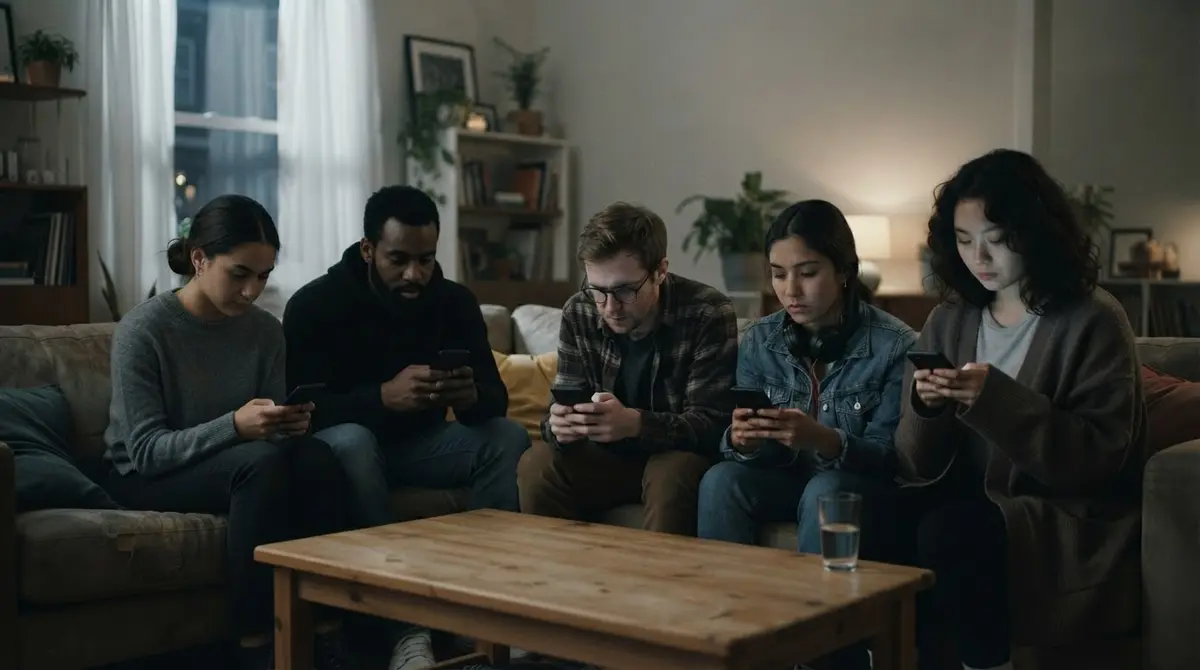
We are, by almost every measure, the most connected generation in human history. We carry the entire internet in our pockets. We can message a friend on another continent in seconds, watch a stranger's whole life unfold on a screen, and join a video call with twenty people at once.
And yet we have never felt more alone.
This is the quiet paradox of modern life: hyper-connected, deeply lonely. The tools that promised to bring us together have, for a lot of people, become a substitute for the real thing. A feed to scroll instead of a table to sit at. The result is a slow, widespread erosion of the in-person bonds that human beings actually need.
It's not just a feeling. It's a public health crisis.
For years, loneliness was treated as a private, slightly embarrassing problem, something to push down and not talk about. That's no longer how the science sees it.
In 2023, the U.S. Surgeon General issued a formal advisory calling loneliness and social isolation an epidemic, warning that the health toll of being chronically disconnected can rival smoking up to 15 cigarettes a day. Chronic loneliness is linked to higher rates of heart disease, stroke, dementia, depression, and early death.
The numbers behind that warning are stark. A landmark meta-analysis of 148 studies found that people with strong social relationships had a 50% greater likelihood of survival than those with weaker ones. Connection isn't a luxury. Biologically, it behaves more like food or sleep.
The World Health Organization reached the same conclusion. In 2023 it declared loneliness a pressing global health threat and launched a Commission on Social Connection to treat it as the priority it is.
Loneliness isn't a character flaw or a personal failing. It's a signal, the social equivalent of hunger, telling us something essential is missing.
We want connection. We just can't reach it.
Here's the part that often gets missed: most lonely people aren't antisocial. They desperately want connection. They simply can't seem to bridge the distance between wanting it and having it.
That gap is real and it's growing. Research from the Survey Center on American Life found that in 1990, only about 3% of Americans said they had no close friends. By 2021, that figure had climbed to roughly 12%. Over the same period, the share of people with large, close friend groups shrank. We aren't just lonelier. We have fewer people to call.
Why? Adulthood quietly dismantles the structures that used to make friendship automatic. School ends. People move for work. Schedules calcify. The casual, repeated, unplanned contact that turns acquaintances into friends has been thinning out for a generation. The "third places" sociologists have written about for decades, the corner café, the rec league, the front porch, keep disappearing.
So we're left with a strange modern problem. You can have a hundred contacts in your phone and still have no one to grab a coffee with on a random Tuesday. The desire is there. The path to acting on it isn't.
The missing ingredient is spontaneity
Think about how friendships actually formed earlier in life. Almost none of them came from a calendar invite three weeks out. They came from proximity and repetition and low-stakes, in-the-moment togetherness. "We're heading to the courts, come." "A few of us are grabbing food, you in?"
That kind of spontaneous, in-person plan is exactly what adult life makes hard. Reaching out feels like an imposition. Coordinating feels like work. The fear of being the one who "wants too much" keeps a lot of us from ever sending the message. So the default becomes staying home again, and the loneliness compounds.
But the underlying human wiring hasn't changed. People still light up at a genuine invitation. They still want to be asked. The problem was never desire. It was the absence of an easy, safe, low-pressure way to turn "I wish I had plans" into actual plans with actual people nearby.
Bridging the gap
That gap, between the connection people want and the connection they can reach, is the whole reason Let's exists.
We aren't trying to add another feed to scroll or another reason to stare at a screen. We're trying to do the opposite: make it effortless to get off the phone and into the same room as someone. Post a simple plan, see what's happening around you, and meet the people nearby for a hike, a coffee, a pickup game, a movie tonight. Because every host is ID-verified and locations stay approximate until you're approved, it's easy to take that first step and feel safe doing it.
Loneliness is one of the defining health challenges of our time. It won't be solved by a single app, and we won't pretend otherwise. But the solution starts somewhere small and stubbornly human: one real plan, one new face, one ordinary afternoon that turns into a memory.
The connection you're looking for is closer than it feels. Sometimes it's a few blocks away.
Sources
- U.S. Surgeon General, Our Epidemic of Loneliness and Isolation (2023). hhs.gov/surgeongeneral
- World Health Organization, Commission on Social Connection (2023). who.int
- Holt-Lunstad J., Smith T.B., Layton J.B. (2010), Social Relationships and Mortality Risk: A Meta-analytic Review, PLOS Medicine. doi.org/10.1371/journal.pmed.1000316
- Survey Center on American Life, The State of American Friendship: Change, Challenges, and Loss (2021). americansurveycenter.org
- Robert D. Putnam, Bowling Alone: The Collapse and Revival of American Community (2000)