Gallup has been asking Americans whether they drink alcohol since 1939. In its most recent survey, only 54% said yes, the lowest share the pollster has ever recorded, down from 62% just two years earlier. Among adults under 35, the drop is even sharper: from 59% in 2023 to 50% in 2025. For the first time, a majority of Americans, 53%, now say even one or two drinks a day is bad for their health.
That is not a dry spell. That is a generation quietly rewriting one of the default settings of adult social life, and it is happening faster than most of the places built around drinking can keep up.
Here is the part nobody planned for: so much of how adults meet people, catch up with old friends, and mark the transition from "coworker" to "friend" still runs through a drink in hand. Cut that out, and you do not just lose a beverage. You lose the default invitation, the default venue, and sometimes the default excuse to show up at all. The sober curious movement is not just a health trend. It is quietly exposing how thin the rest of adult social infrastructure has become.
The scale of the shift
The numbers are not subtle. Nearly half of Americans, 49%, say they are trying to drink less in 2025, a 44% jump from just two years before, according to Circana's Sober Curious Nation survey. Gen Z is leading it: 65% plan to cut back this year, and 39% say they are aiming for a fully dry year. A quarter of American adults did not have a single drink in 2024, and 19% of Gen Z say they do not drink at all.
Dry January, once a niche resolution, drew 30% of Americans in 2025, up 36% from the year before. Nonalcoholic beer purchases rose 22% year over year, and 58% of people surveyed said they planned to try a nonalcoholic drink this year. This is not a small subculture experimenting on the margins. It is a meaningful share of the adult population changing a habit that used to be load-bearing for a lot of their social calendar.
The reasons line up with what you would guess if you have felt any of this pull yourself. Leger's research on Gen Z and millennials found the top motivations are personal choice (53%), health and well-being (48%), and money (39%). Circana's data backs that up: better physical health, saving money, and improving mental health top the list of reasons people give for cutting back. Alcohol is not cheap either. Circana found the average American spends about $105 a month on it, money an increasing number of people would rather put toward rent, travel, or, notably, the very hobbies and outings that are now stepping in to replace the bar tab.
The part that catches people off guard
Deciding to drink less turns out to be the easy part. The harder discovery, the one that rarely makes the trend pieces, is how much of adult socializing was quietly built around alcohol as the default activity. Happy hour is the default way coworkers turn into friends. A bar is the default place to meet someone's friend group for the first time. "Grab a drink sometime" is the default text you send an old friend you have not seen in months. Take the drink out of any of those, and a surprising number of people realize they do not actually have a backup plan.
It shows up as friction almost immediately. Circana found that 30% of non-drinkers feel judged for their choice, and 41% say they have been directly asked why they are not drinking, often at the exact moment they were hoping to just enjoy the party. That kind of low-grade social tax adds up. It is one thing to change your own habits. It is another to keep doing it in rooms that were not designed with you in mind.
This is the same gap we wrote about in the third place crisis: so many of the "places" people used to build friendships around, bowling leagues, church basements, the corner bar with the same regulars every Thursday, have been quietly closing for decades. Bars were one of the last third places standing for a lot of adults. Sober-curious adults are now discovering that gap from the inside, at exactly the moment they need it filled.
It even changes how existing friendships get maintained, not just new ones. "Let's grab a drink sometime" is one of the most common ways adults keep loose ties alive between the big life updates, a low-effort way to say I still want you in my life without having to plan much. Take drinking off the table and that text suddenly requires an actual idea: a place, a time, a thing to do together. Some people find that a relief. Plenty more find it is the reason a friendship they meant to keep up with quietly goes another six months without a plan.
The market is racing to catch up
To its credit, the market has noticed fast. Eventbrite data reported by Yahoo shows sober-curious events on the platform grew 92% between 2023 and 2024, everything from morning dance parties, up 20%, to DJ nights built around coffee instead of cocktails, up 478%. Circana found 41% of Gen Z are interested in visiting a dedicated sober bar, and 22% of Americans overall plan to in 2026, chasing the social atmosphere of a bar without the pressure to order a drink to belong there.
Work culture is adjusting too, more slowly. As one piece on the shift put it, young professionals who drink less are "navigating networking culture while redefining belonging beyond alcohol," building trust through shared experiences and common goals rather than the drink itself. That is a promising instinct, but it also means the burden of inventing an alternative still falls mostly on individuals and their friend groups, one awkward happy-hour substitution at a time, rather than on any built-in system for finding each other.
What's actually replacing the bar
Look past the headlines about mocktail menus and the pattern is consistent: the things filling the gap are almost never a direct swap, a sober bar standing in for a regular one. They are activities that never needed alcohol to work in the first place, and that turn out to build friendship faster because of it.
Run clubs are the clearest example. We covered the run club boom in depth recently: club memberships nearly quadrupled on Strava in a single year, and Gen Z is 39% more likely than Gen X to use fitness specifically to meet people. Nobody is drinking at 6:30 a.m., which is exactly the point. The shared activity does the work a drink used to do, breaking the ice and giving people something to talk about, without any of the pressure or expense.
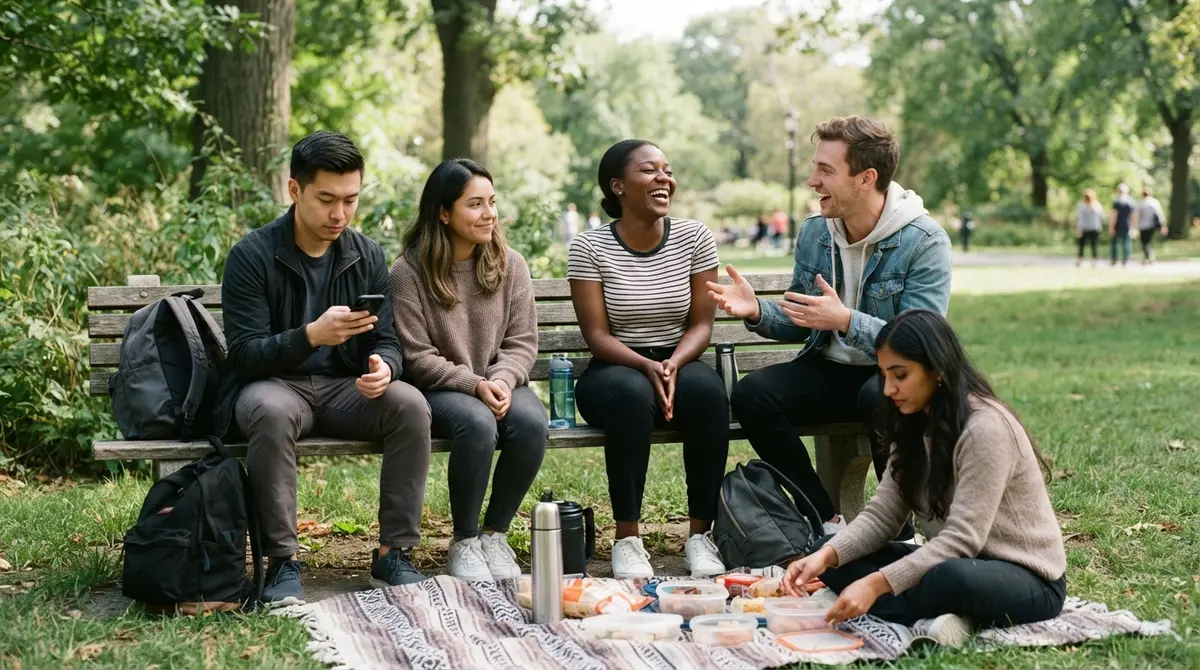
The same logic shows up everywhere sober-curious communities gather: climbing gyms, where people often show up alone and start chatting mid-route; hiking and walking groups; board game nights; book clubs; pickup sports; coffee meetups that run on caffeine instead of anything stronger. Some cities now have entire alcohol-free social calendars built around exactly this, morning run-then-coffee groups, weekday climbing meetups, Sunday potlucks with a non-alcoholic drink pairing instead of wine. None of these are new inventions. What is new is how many people are actively choosing them as their primary way to meet people, rather than as a fallback for the nights they happen not to feel like drinking.
It also quietly solves a problem specific to meeting brand-new people rather than maintaining old friendships. A bar puts the burden of conversation entirely on two people facing each other with nothing else to do. An activity gives everyone a third thing to focus on, the climb, the trail, the board, the puzzle, which takes the pressure off having something clever to say every thirty seconds. That is a big part of why people describe these meetups as easier to walk into alone than a bar ever was. Nobody there is measuring how many rounds you have kept up with. They are just there to do the thing.
There is a real mechanism behind why this works better, not just differently. A shared activity gives people something to focus on besides each other, which lowers the performance pressure that comes with sitting across a table making conversation. It also, almost by accident, restores the "same time, same place, same people" repetition that built friendships automatically for previous generations before third places started disappearing. A sober bar can replicate part of the atmosphere of a regular one. A run club, a climbing session, or a Sunday hike replicates the actual mechanism that turns strangers into friends: doing something together, more than once, with nothing riding on the small talk in between.
Building the plan without the default
None of this means the sober curious movement created a friendship problem. It surfaced one that was already there, hiding behind a round of drinks that made it easy not to notice how little structure was underneath. The fix is not finding the perfect zero-proof bar. It is rebuilding the plan itself: something specific, at a specific time, that does not depend on anyone ordering anything.
That is the exact problem Let's, the IRL app, exists to solve. Instead of defaulting to "let's grab a drink" because it is the easiest plan to propose, you can post what you actually want to do, a coffee, a hike, pickleball, a movie tonight, and see who nearby wants in. It matches people on the activity, not a profile or a bar tab, which means the plan works exactly as well for someone three weeks into Dry January as it does for anyone else. Every host is ID-verified, your location stays approximate until a host approves you in, and a private mode lets you run the same kind of standing plan with your own friends first, if that is where you would rather start.
If a night out used to mean one thing by default, this is a good moment to notice how many other things it could mean instead. The friendships that used to form over a shared pitcher can just as easily form over a shared trail, a shared game, or a shared pot of coffee. The people are still out there wanting the same connection they always did. The easiest way to find them is still to see what's happening nearby and show up, drink optional.
Sources
- Gallup, Americans' Drinking Remains at Record Low (2025). news.gallup.com
- Circana, Sober Curious Nation: Alcohol Survey (2025). circana.com
- Leger, Beyond the Buzz: 2025 Sober Curious Report. leger360.com
- Eventbrite data via Yahoo News, The Sober Curious Generation (2025). yahoo.com
- Platform Magazine, Networking Without the Cocktail: The Rise of the Sober Professional (2026). platformmagazine.org