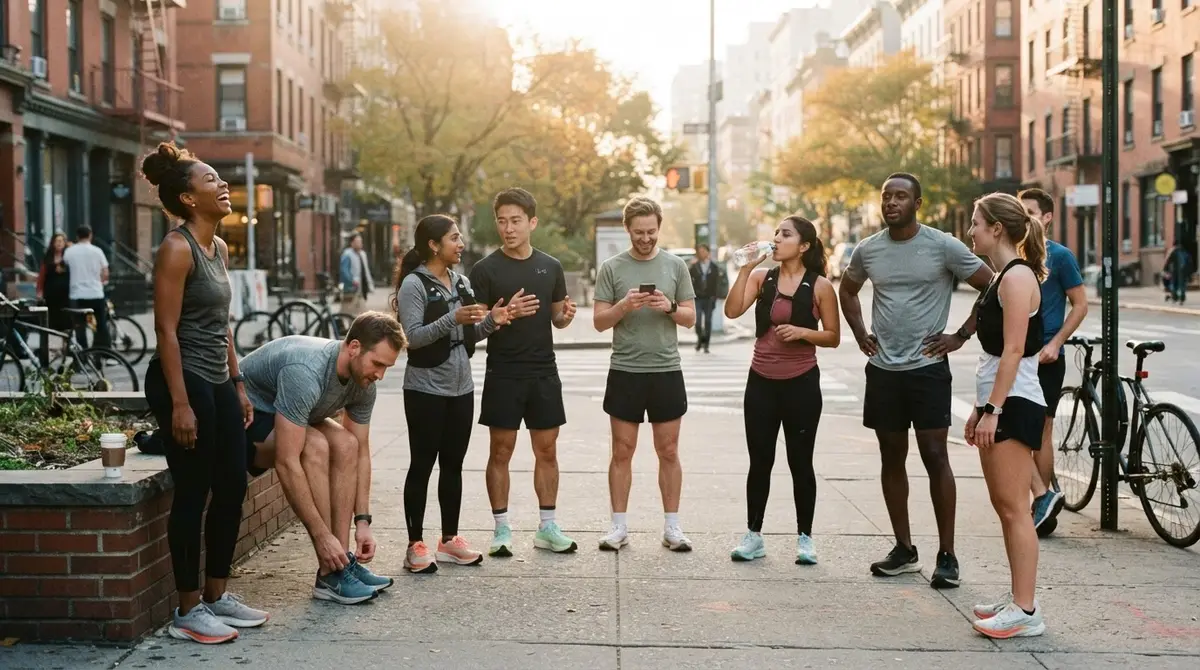
Walk past almost any city park on a Saturday morning right now and you will see it: a loose cluster of twenty, forty, sometimes a hundred people in running shoes, stretching, talking, waiting for someone with a bullhorn to say go. Five years ago that same park had a handful of solo runners with earbuds in, heads down, headed nowhere near each other.
Something shifted. And it was not really about running.
It shifted against a pretty bleak backdrop. The U.S. Surgeon General's advisory on loneliness put a number on what a lot of adults already felt: chronic disconnection carries health risks comparable to smoking up to 15 cigarettes a day. That advisory landed in 2023. What has happened in the two years since is not that Americans suddenly stopped being lonely. It is that a specific, low-cost fix quietly scaled up in public parks everywhere, and enough people found it that it started showing up in the data.
Strava's most recent Year in Sport report found that new clubs on its platform nearly quadrupled in a single year, pushing the total past one million. Running clubs specifically grew 3.5x. Hiking clubs grew even faster, 5.8x, and club-organized events, actual scheduled meetups, not just app groups, rose 1.5x. That last number matters most. People are not just joining clubs online. They are showing up, in person, on a recurring schedule, which is precisely the ingredient that has been missing from adult social life for a generation.
The numbers behind the boom
The clearest signal in the data is who is driving it. Strava found that Gen Z is 39% more likely than Gen X to use fitness specifically to meet people who share their interests, and more than half plan to use the app even more in 2026 while easing off Instagram and TikTok. Sixty-four percent said they would rather spend money on running gear than on a date. Read that as a generation choosing a 6 a.m. group run over a single dinner with one stranger, because the group run has better odds of turning into something that lasts.
That tracks with what researchers keep finding about making friends as an adult: the biggest obstacle usually is not motivation. It is structure. Once you are out of school, nothing automatically puts you in a room with the same people, at the same time, every week. Run clubs quietly rebuild that structure. Same corner, same 6:30 a.m., same route, week after week, until the strangers next to you stop being strangers.
And this is not purely a Gen Z habit that older generations are borrowing. Strava's own numbers, and casual observation at any club meetup, suggest millennials and Gen Xers make up a real share of the boom too, just for a slightly different reason. Where younger members tend to frame it as meeting people, older members more often describe it as maintaining a friend group that would otherwise scatter once everyone has kids, changes jobs, or moves to the suburbs. The mechanism is identical either way. A standing appointment with other people is one of the only things that reliably survives a chaotic decade.
People aren't showing up for the miles
Talk to anyone who has actually joined one and the pattern is consistent. The run is the excuse. The point is the twenty minutes of coffee afterward, the group chat that starts buzzing the night before, the person who remembers you mentioned a rough week and asks how it went the next time you see them.
This is not a coincidence of modern branding. It is how a lot of Gen Z and younger millennials are explicitly choosing to meet people now, instead of at bars or through dating apps. Several run clubs built specifically around this, like Friday Night Lights and Manhattan's The Say Yes Club, have grown almost entirely through word of mouth. "It is so hard to make friends in London," Say Yes Club founder Esmée Gummer told Service95, "and yet I've watched genuine friendship circles form, people even booking holidays together, and it all started with a run."
That is worth sitting with. Not a friendly acquaintance. A whole friendship circle, from a Tuesday night loop around the block.
Why side by side works better than face to face
There is real psychology behind why this format, specifically, produces friendships faster than a lot of alternatives. A 2020 study published in PLOS One had strangers walk side by side, some in silence, some talking, and measured how their footsteps synchronized along with how they rated each other afterward. Paired walkers who formed a better first impression synchronized their steps more closely, and simply walking alongside another person, even without talking, was enough to shift how favorably they viewed each other.
Compare that to the format most adult socializing still runs on: sitting across a table, making eye contact, filling silence with performance. A run strips that pressure out entirely. You are moving in the same direction, breathing at the same pace, and the conversation can start, stall, and pick back up again without anyone feeling the need to fill dead air. It is closer to how kids become friends, side by side on a playground, doing a thing together, than how adults are usually told to network.
It also explains why this beats a lot of what came before it. A bar requires performing over noise. A dating app requires performing in text before you ever meet. A run club requires only that you show up and put one foot in front of the other, which turns out to be a much lower bar to clear.
It's bigger than running
Running just happens to be the version that is easiest to measure, because it lives inside one app with public data. But the same pattern is showing up anywhere a group meets on a fixed schedule to do something physical together. Walking clubs, pickleball meetups, bouldering nights at the climbing gym, recreational soccer leagues that used to be dominated by ex-athletes are now filling up with total beginners who signed up specifically because a friend, or a friend of a friend, said the group was a good way to meet people. Call it social fitness: exercise as the vehicle, connection as the actual product being purchased.
What makes running the flagship example is how low the barrier is. Pickleball needs a court and a paddle. Climbing needs a gym membership and gear. Running needs shoes you probably already own and a sidewalk. That is likely a big part of why it scaled the fastest: nothing stood between "I want to try this" and "I showed up," which is exactly the friction that keeps a lot of well-meaning New Year's resolutions from ever becoming a friendship.
The safety calculus nobody talks about
There is another, less discussed reason group running took off, especially for women: running alone has real, well-documented risk. A widely cited Runner's World survey found that 43% of women said they had experienced harassment while running, compared to 4% of men, with the number climbing to 58% among women under 30. Nearly a third reported being followed. Sixty percent of all runners said they limit their runs to daylight hours as a result.
Against that backdrop, a club is not just a nicer way to run. It is a safer one, and that safety is itself a form of connection. Groups like Friday Night Lights and These Girls Run were built specifically to reclaim evening hours that felt off-limits to women running alone, turning a genuine safety workaround into one of the more reliable ways to build a real social circle. Strength in numbers, in the most literal sense, doubling as a friendship engine.
The third place we built for ourselves
Sociologists have spent decades warning that Americans are running out of "third places," the cafes, rec leagues, and front porches that used to manufacture casual, repeated contact with the same people. Run clubs are, functionally, a third place that a generation built for itself because the old ones kept closing. No membership fee, no reservation, no algorithm deciding who you match with. Just a meeting point and a shared activity, which is also exactly how the best casual, low-stakes friendships tend to start: not through a deep one-on-one conversation, but through showing up repeatedly around the same people doing the same thing.
It is not only a Gen Z story, either. Men in particular have been shown to lose friendships fastest after their twenties, in what researchers now call a friendship recession, and a standing weekly run solves the exact problem that recession describes: no built-in excuse to see the same guys twice. A run club manufactures that excuse automatically, every single week, whether anyone feels like reaching out that day or not.
What if running isn't your thing
Here's the honest caveat: not everyone wants to run at 6 a.m., and a lot of people will read all of this and think, correctly, that is not for me. That's fine. The actual lesson from the run club boom is not "everyone should run." It is that a shared, recurring activity with a fixed time and place is the single most reliable structure for turning strangers into friends, and running just happens to be the version that is cheap, needs no equipment, and scales to any city block. The same mechanics work for a pickup basketball run, a weekly board game night, a climbing gym session, or a coffee walk. What matters is the "same time, same place, same people" part, not the sport.
That is the exact gap Let's, the IRL app, was built to close. Instead of hoping you stumble into the right run club or waiting for someone else to organize the standing Tuesday game, you can post what you actually want to do (a run, pickleball, a coffee, a movie tonight) and see who nearby wants in. It matches people on the activity, not a profile photo, which is the same reason side-by-side movement builds trust faster than sitting across a table making small talk. Every host is ID-verified, locations stay approximate until a host approves you, and a private mode lets you organize the same kind of standing plan with your own circle of friends instead of strangers, if that's what you'd rather do first.
The run club boom is really proof of something simple: people still want exactly what they always wanted, a regular reason to see the same familiar faces. They just needed an easier way to find something happening nearby and show up. Whether that's a 6:30 a.m. loop around the park or a Thursday pickup game, the friendships form the same way they always have. Repetition, low stakes, and someone willing to say "come."
Sources
- Strava, 12th Annual Year in Sport Trend Report (December 2025). press.strava.com
- Miyata K. et al., Paired walkers with better first impression synchronize better, PLOS One (2020). journals.plos.org
- CBS News New York, Runner's World survey on harassment of female runners (2024). cbsnews.com
- Service95, A New Wave of Women Are Rediscovering the Joy of Movement. service95.com
- U.S. Surgeon General, Our Epidemic of Loneliness and Isolation (2023). hhs.gov/surgeongeneral