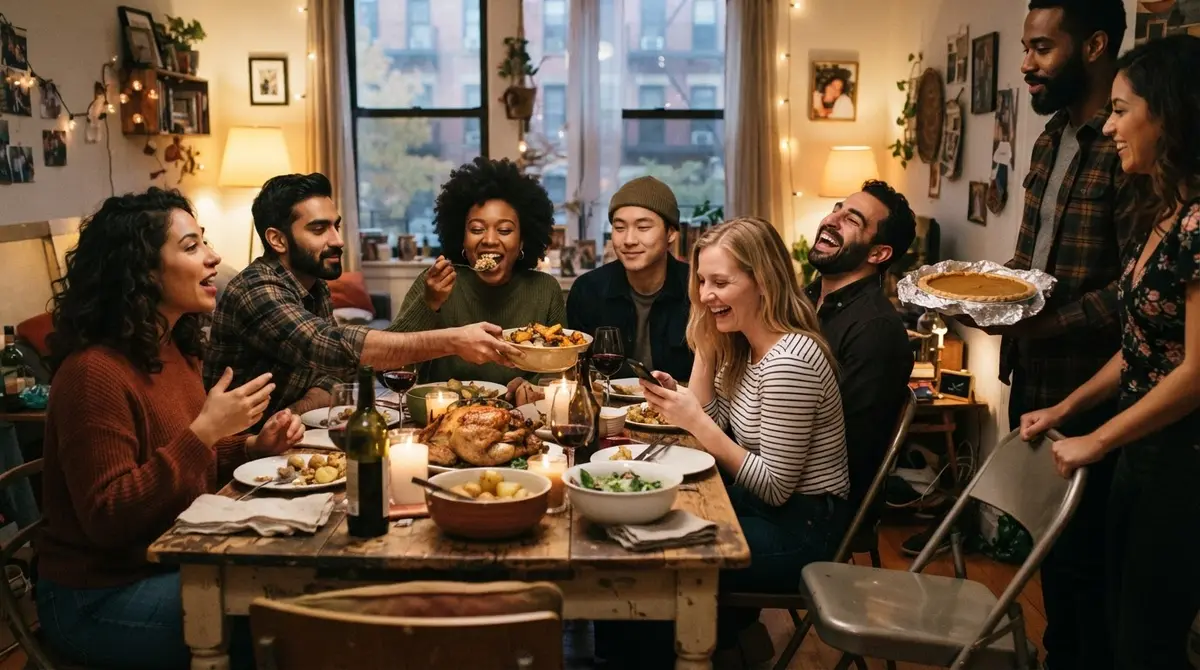
Picture the group chat around this time of year. Flights are getting booked. Someone is asking who has the good roasting pan. Someone else is already complaining about their uncle. It all looks like everyone has somewhere to be.
Now picture the people who are not in that chat at all. The coworker who moved here in March and has not mentioned any plans. The neighbor whose family lives three time zones away. The friend who went quiet about the holidays after a rough year with their parents. They are not posting about it, which is exactly why it is so easy to miss.
Here is what the numbers below suggest: the person spending the holiday alone is rarely a stranger. They are usually someone one step away from you, and the gap between their quiet November and a seat at a full table is often a single text. This piece is about that gap, why it is wider this year than you might think, and why closing it is one of the easiest generous things you can do before the end of the month.
Holiday loneliness is common, it just doesn't post
The holidays sell togetherness so hard that being on the outside of it can feel like a personal failure. It is not. It is extremely common.
Last December, a survey of 3,001 U.S. adults commissioned by A Mission for Michael (AMFM) estimated that roughly 14 million Americans would wake up alone on Christmas morning. The reasons were mostly practical, not personal:
- 29% said they live too far from family or friends
- 20% were staying away because of family conflict
- 17% said travel was simply too expensive
- 16% said they genuinely preferred to be alone
That last group matters (some people really do love a quiet holiday, and that is fine). But notice that the biggest reasons are distance, cost, and complicated families. Those are circumstances, not choices. And 59% of respondents in the same survey said Christmas magnifies loneliness more than any other time of year.
The broader backdrop is not rosy either. The American Psychological Association's Stress in America 2025 survey of 3,199 adults found that at least some of the time, 54% of Americans feel isolated, 50% feel left out, and 50% feel they lack companionship. Nearly seven in ten (69%) said they needed more emotional support over the past year than they actually got, up from 65% the year before.
And loneliness is not just a young-person problem or an old-person problem. AARP's 2025 research found that 40% of adults 45 and older are lonely, up from 35% in 2018, with the highest rate (46%) among people aged 45 to 59. Among lonely adults, 45% said they had fewer friends than five years earlier.
Put those numbers together and the math is simple. If you know twenty people, there is a very real chance that at least one of them does not have a table to sit at this month.
The quiet rise of eating alone
There is a specific, measurable piece of this that the holidays put under a spotlight: meals.
The World Happiness Report 2025 devoted an entire chapter to sharing meals, using Gallup data from 142 countries. Two findings stand out.
First, eating alone has become startlingly normal in the U.S. In 2023, about 1 in 4 Americans (26%) said they ate every single meal alone the previous day. That is roughly a 53% increase since 2003, and the rate was higher in 2023 than at the peak of the pandemic. Among 25 to 34 year olds, the share eating all their meals alone rose by more than 180% over two decades. The researchers found that the rise in single-person households explains only 15 to 20% of that jump, so this is not just about living alone. It is about how rarely we sit down with anyone.
Second, shared meals are tightly linked to wellbeing. People who share more meals report higher life satisfaction, more positive emotions, and fewer negative ones, across ages, genders, and countries. The authors describe meal sharing as an indicator of wellbeing "on par with income and unemployment," even after controlling for factors like income and education. They are careful to note they cannot prove which way the arrow points (happier people may also share more meals), but the association is strong and consistent.
That is part of why a holiday built around a meal can sting so much when you are on the outside of it. And it is also why inviting someone to that meal carries more weight than it seems to.
Why Friendsgiving took off
If you have hosted or attended a Friendsgiving, you already know the appeal. No seating politics. No one asking when you are getting married. A table full of people who chose each other.
The numbers back up what your group chat already knew. In Empower's Table Stakes study, a nationally representative online survey of 2,200 adults fielded in September 2025, nearly 40% of Americans said Friendsgiving is becoming a new tradition for them, rising to 46% of millennials. YPulse reported that participation among the young adults it tracks rose from 42% in 2024 to 44% in 2025, and in the U.K., the "Friendmas" version is now celebrated by about 30% of people and 45% of Gen Z.
A few things are driving it:
- Cost. The same Empower study found that 53% of Americans think Thanksgiving travel is too expensive, and 26% planned to skip Thanksgiving because of cost. A potluck across town is a lot cheaper than a flight across the country.
- Distance. More adults live far from where they grew up, which is the single biggest reason people in the AMFM survey gave for spending the holidays alone.
- Choice. For many people, especially those with complicated families, a friend-built holiday is not a backup plan. It is the main event.
- Lower stakes. 57% of Americans in the Empower study said they find Thanksgiving stressful, rising to 64% of Gen Z. A Friendsgiving can be as casual as everyone wants it to be.
Friendsgiving is, in a sense, a cultural workaround for the exact problems the loneliness data describes. It is people looking at the gap between "I want to celebrate" and "I have people to celebrate with" and simply building the table themselves.
The extra chair is the whole point
Here is where it gets interesting. Most Friendsgivings form around an existing friend group: the college roommates, the work crew, the people from the same building. That is lovely. It also means the people who most need a table, the newcomer, the recently divorced friend, the coworker whose family is far away, are often the ones who are never quite in the loop.
Not because anyone is excluding them. Because no one thought to ask.
We have written before about how people underestimate how welcome they are when they ask to join plans. The flip side is just as important. Many of the people who would love a seat at your table will never ask for one. Asking to join a holiday dinner feels even riskier than asking to join a Saturday hike, because the holiday carries all that extra meaning. So they stay quiet, and the empty chair stays empty.
That is why the single most valuable thing a Friendsgiving host can do is set one more place than they need, and then go fill it on purpose.
How to be the person who asks
You do not need to throw a 20-person feast to make a difference. Here are a few simple ways to close the gap this month.
Do a quiet roster check
Before you finalize the guest list, scroll through your contacts and ask yourself: who here might not have plans? Look for:
- Someone who moved to your city in the last year or two
- Someone whose family lives far away or who has mentioned a strained relationship with them
- Someone who went through a breakup, divorce, or loss this year
- Someone who works in healthcare, hospitality, or retail and might be stuck near work over the holiday
- Someone you like but have only ever seen in one context (the gym, the office, the dog park)
That last category matters more than you think. Research on casual "fringeship" friendships shows that weak ties are often one good invitation away from becoming real friendships. A holiday meal is one of the most natural upgrades there is.
Make the invite easy to say yes to
How you invite someone matters. A vague "you should come by sometime!" is easy to wave off. A specific, low-pressure invite is much easier to accept.
Try something like: "We're doing a Friendsgiving on the 22nd, very casual, around six people. We'd love to have you if you're around. No pressure either way, and no need to bring anything."
That message does several things. It gives a date. It signals that the event is small and relaxed. It makes clear you actually want them there. And it lets them decline without awkwardness, which, counterintuitively, makes a yes more likely.
Make the newcomer feel like a regular
The hardest part of arriving at someone else's tradition is feeling like a guest at a party everyone else has been to before. A few small moves help:
- Give them a job. Asking someone to bring ice, carve, or run the playlist instantly makes them part of the event instead of an observer.
- Introduce them with a hook. "This is Sam, she just moved here from Denver and is a ridiculously good rock climber" gives everyone at the table an easy way in.
- Seat them next to someone warm. Not the quietest person, not the host who will be running around all night.
- Follow up. A quick "so glad you came, let's do something in December" text the next day turns a one-off dinner into the start of something.
Keep it simple, seriously
The biggest reason people do not host is that they think it has to be impressive. It does not. We dug into this in why we stopped hosting friends, and the takeaway still holds: people remember how they felt at your table, not whether the gravy came from a jar.
A rotisserie chicken, a couple of sides, and a store-bought pie is a Friendsgiving. A potluck where everyone brings one dish is a Friendsgiving. Takeout eaten on the floor of a half-furnished apartment is absolutely a Friendsgiving. The Empower study found that 38% of Americans planned to serve roasted chicken instead of turkey last year, and 42% planned a scaled-down meal. Nobody is grading you.
If you are the one without a table
Maybe you read the first section and recognized yourself. If so, you are in very large company, and there is nothing wrong with you. Distance, cost, work, and family circumstances leave millions of capable, likable people without holiday plans every single year.
A few things that genuinely help:
- Tell one person. A simple "I'm actually staying in town for Thanksgiving this year, what are you up to?" gives friends the opening many of them are looking for. Research on asking to join plans suggests people are far happier to include you than you expect.
- Host something tiny. You do not need a big group. Inviting two other people who are also staying in town counts. Chances are you know at least one person in the same spot.
- Look for what is happening nearby. Plenty of people post open-invite dinners, morning-of Turkey Trots, volunteer shifts, and post-holiday hikes. Browsing what's happening near you is a good way to find something low-key.
- Plan the day after. If the holiday itself is hard, give yourself something on Friday or Saturday to look forward to: a movie, a walk, a pickup game. Having one plan on the calendar changes how the whole weekend feels.
And if you are someone who prefers a quiet holiday, enjoy it. Solitude you choose is very different from isolation you did not.
Why this matters beyond one dinner
It would be easy to treat all of this as a holiday nicety. It is more than that.
The APA's survey found that 92% of Americans name relationships as a key source of meaning in their lives, with 62% pointing specifically to friendships. As the APA's chief executive, Arthur Evans Jr., put it when the survey was released: "Reaching out, showing up and building community are not optional, they're essential."
The holidays are one of the few times of year when reaching out has a built-in excuse. Nobody wonders why you are inviting them to dinner on Thanksgiving week. That makes it the perfect moment to turn an acquaintance into a friend, to check in on someone who has drifted, or to welcome someone new into a group that has been closed for a while.
The friendships that last are rarely built in one big moment. They are built through repeated, ordinary time together, and a shared meal is one of the oldest and most reliable ways to start that cycle. Today's newcomer at your Friendsgiving can easily become next year's co-host.
Pull up the chair
Here is a simple challenge for this month: invite one person to your holiday table who would not otherwise have been there. Just one. Do the roster check, send the specific, low-pressure text, and give them a job when they arrive.
If you are on the other side of it, send one message letting someone know you are around. Odds are good that someone is hoping to hear from you, too.
This is exactly the gap Let's was built to close. You can post the plan you actually want to make happen, whether that is a Friendsgiving potluck, a morning Turkey Trot, or a "staying in town, who wants to watch football?" hangout, and people nearby who want the same thing can ask to join. You approve who gets in, hosts are ID verified, and the location stays approximate until you say yes. If you would rather keep it to your own crew, private mode lets you invite friends directly and organize smaller subgroups. It is live on iOS and Android.
The table does not need to be big. It just needs one more chair than you planned. Somebody is going to be really glad you pulled it up, and next year, they might be the one inviting you. Find something happening nearby or start your own this week.